Monday, May 31, 2010

Flair Additions

So I made some improvements to my developer forum flair!

Firstly, I added a Sun Forums flair, which displays your username, number of posts, and number of Dukes.


The background image to the left changes depending on how many "Dukes" you have, which are like these special points you can get for answering questions. It will also put a star next to your name if you are a moderator.

This one was a little more complicated because I couldn't pass the HTML directly into a DOMDocument object like with JavaRanch. I had to use tidy to clean up the HTML before passing it to DOMDocument:
//tidy the page
$tidy = new tidy("http://forums.sun.com/profile.jspa?userID=$id");
$tidy->cleanRepair();
$tidy = preg_replace('/<\/?nobr>/', '', $tidy); //<nobr> tags must be removed for DOMDocument

//load the page
$html = new DOMDocument();
$html->loadHTML($tidy);
I also had to pretty much do all development on the mangst.com server because the PHP installation on my iMac doesn't have tidy installed and it doesn't support all of the GD graphics functions.

Secondly, I added the ability to view the flair as a dynamically created image (nerdgasm!!!). Just change the "type" parameter to "png" or "jpeg":
<img src="http://www.mangst.com/flair/sun?id=1071155&type=png" />


I was actually surprised how easy this was. I had this fear that generating an image programmatically would be hugely complicated, but it wasn't really. The hardest part was keeping track of the pixels to make sure everything lined up right. I tried to make it look as close as possible to the Javascript and HTML versions, but for some reason the bold version of Verdana comes out looking a lot less bold in the image.

Tuesday, May 25, 2010

JavaRanch Flair

Check out my JavaRanch flair!


I was so inspired by the flair over at Stackoverflow that I thought it would be fun to create my own! It basically works just like Stackoverflow's does. You have three options for how to include it in your webpage:

  • Javascript - You can include it using a <script> tag, which injects the flair into the DOM via Javascript.
    <script
      src="http://www.mangst.com/flair/javaranch?id=209694&type=js"
      type="text/javascript">
    </script>
    
  • HTML - You can include it using an <iframe>, which loads the flair as HTML into the frame.
    <iframe
      src="http://www.mangst.com/flair/javaranch?id=209694&type=html"
      marginwidth="0"
      marginheight="0" 
      frameborder="0"
      scrolling="no"
      width="220"
      height="100">
    </iframe>
    
  • JSON - You can get the raw data with JSON and handle the data however you wish with Javascript.
    JSON URL: http://www.mangst.com/flair/javaranch?id=209694&type=json
On the backend, what it does is it screen scrapes your JavaRanch profile page, plucking out the information that it needs. It uses a PHP DOMDocument object to load the HTML, then uses XPath to get the data fields.
$html = new DOMDocument();
$html->loadHtmlFile("http://www.coderanch.com/forums/user/profile/$id");
$xpath = new DOMXPath($html);
$username = $xpath->query("//span[@id='profileUserName']")->item(0)->textContent;
//...

I think it's pretty elegant, though it will break if JavaRanch decides to do any site redesigns. I was afraid that it wouldn't be able to load the HTML into a DOM, since webpage HTML tends not to be well formed XML, which would have prevented me from using XPath. The SimpleXMLElement class wouldn't accept the HTML, but the DOMDocument class did.

Friday, May 7, 2010

SimpleDateFormat and Thread Safety

SimpleDateFormat
The Java class SimpleDateFormat converts Dates to Strings and vice versa. For example, the following code converts the String "04/15/2010" to a Date object and back again:
DateFormat df = new SimpleDateFormat("MM/dd/yyyy");
Date d = df.parse("04/15/2010");
String s = df.format(d);
"04/15/2010".equals(s); //true
This class is documented as not being thread-safe, but I decided to see for myself if this was true.

Thread-safety proof
I created a program that proves that SimpleDateFormat is not thread-safe. It creates X threads which run concurrently. Each thread generates Y random Dates, then formats each Date in two ways: using a local instance of SimpleDateFormat that no other thread has access to, and using a static instance of SimpleDateFormat which all threads use. The Strings created by the local instance are added to one List and the Strings created by the static instance are added to another List.

If everything is synchronized properly, then these two lists should be identical. But because SimpleDateFormat is not thread safe and all threads use a shared static instance, the lists do not always come out identical (I've found that around ten threads and ten dates-per-thread consistently produce different lists).

If the call to "staticDf.format()" is wrapped in a synchronized block, then the lists always come out identical, which shows that SimpleDateFormat needs to be manually synchronized and is therefore not thread-safe.

Usage
The following command will create ten threads, each of which will generate twenty dates:
java SimpleDateFormatThreadSafe 10 20

Source code
import java.text.DateFormat;
import java.text.SimpleDateFormat;
import java.util.ArrayList;
import java.util.Calendar;
import java.util.Date;
import java.util.List;

/**
 * Proves that SimpleDateFormat is indeed not thread safe (as documented in the
 * javadocs).
 * @author mangstadt
 */
public class SimpleDateFormatThreadSafe {
  private static final String format = "MM/dd/yy";
  private static final DateFormat staticDf = new SimpleDateFormat(format);
  private static int numThreads = 10;
  private static int numLoopsPerThread = 10;

  public static void main(String args[]) throws Exception {
    //get the arguments
    if (args.length > 0){
      numThreads = Integer.parseInt(args[0]);
      if (args.length > 1){
        numLoopsPerThread = Integer.parseInt(args[1]);
      }
    }

    //create the threads
    MyThread threads[] = new MyThread[numThreads];
    for (int i = 0; i < threads.length; ++i) {
      threads[i] = new MyThread();
    }

    //start the threads
    for (MyThread t : threads) {
      t.start();
    }

    //check the results
    boolean allIdentical = true;
    for (MyThread t : threads) {
      t.join();
      if (!t.localList.equals(t.staticList)){
        System.out.println(t.getName() + " lists are different:");
        System.out.println("local:  " + t.localList);
        System.out.println("static: " + t.staticList);
        System.out.println();
        allIdentical = false;
      }
    }
    if (allIdentical){
      System.out.println("All lists are identical.");
    }
  }

  private static class MyThread extends Thread {
    public final List localList = new ArrayList();
    public final List staticList = new ArrayList();

    @Override
    public void run() {
      DateFormat localDf = new SimpleDateFormat(format);
      for (int i = 0; i < numLoopsPerThread; ++i) {
        //create a random Date
        Calendar c = Calendar.getInstance();
        c.set(Calendar.MONTH, randInt(0, 12));
        c.set(Calendar.DATE, randInt(1, 21));
        c.set(Calendar.YEAR, randInt(1990, 2011));
        Date d = c.getTime();

        //add formatted dates to lists
        localList.add(localDf.format(d));
        //synchronized (staticDf){
        staticList.add(staticDf.format(d));
        //}
      }
    }
  }

  private static int randInt(int min, int max) {
    return (int) (Math.random() * (max - min) + min);
  }
}

Sunday, April 11, 2010

The Data URI

Typically, an image is included in a web page by referencing an image file:

<img src="take-this.jpg" />


But it's also possible to put the image directly inside the web page source. This is done using a data URI:

<img src="data:image/jpeg;base64,image-data-goes-here" />


The URI contains the content-type of the image ("image/jpeg" in this case, since this image is a JPEG) and the image data encoded in base64.

This is supported by most browsers. Internet Explorer support lags behind, with only version 8 supporting it (to a limited extent).

This technique shouldn't be used on a regular basis, since it bloats the size of the web page considerably and makes it take longer to load. Including images as separate files (the typical way) lets the user explore the page while the more bandwidth intensive images are loading.

Check out my Data URI Generator to generate a data URI from an image of your choosing.

Thursday, April 8, 2010

Bad HealthVault Method Schema URLs

One thing to note when working with the HealthVault XML method schemas is that the links to these schemas in the HealthVault Developer Center (http://developer.healthvault.com/methods/methods.aspx), as well as in the GetServiceDefinition response, are not always correct. Some versions of some methods refer to the version 1 schemas, when they actually have their own schemas.

For example, the URL to the GetThings3 request schema is listed as:

https://platform.healthvault-ppe.com/platform/XSD/method-getthings.xsd

This URL incorrectly points to the version 1 schema. The version number must be added to the end of the file name in order to get the correct schema:

https://platform.healthvault-ppe.com/platform/XSD/method-getthings3.xsd

This holds true for the following methods:

CreateConnectPackage2 request
GetServiceDefinition2 response
GetThings3 request, response
OverwriteThings2 request
PutThings2 request

Saturday, March 27, 2010

Creating a Connect-Request in HealthVault

I've been doing a lot of work with Microsoft HealthVault at my job lately. I did some experimental work with the platform when I first started working there and since then, I've sort of been the team's HealthVault expert. It's been fun learning all about it and challenging as well, since most of the HealthVault libraries, tutorials, etc are centered around .NET (we use Java). So HealthVault is something I think would be fun to blog about.

This blog post will be about how to use what are called connect-requests in HealthVault. It assumes that you already have some knowledge of HealthVault from a developer's perspective. It includes Java code samples that use the JAX-B classes from the HealthVault Java Library.

Connect-requests are used by non web-based applications to create a connection to a HealthVault record. The process must only be completed once--not every time the application wants to access the record. They work like this:
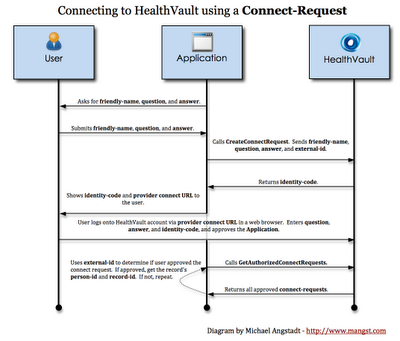


1 The application prompts the user for the following information:

  • Friendly name - This can be anything, but should be the name that's on the HealthVault record.

  • Question - A question of the user's choosing (such as "What high school did I go to?").

  • Answer - The answer to the above question.

2 The application uses the above information, along with an external-id, to create a connect-request. The external-id can be any value that uniquely identifies the connect-request (the current time in milliseconds works fine). This value must be saved somewhere, as the application will need to use it again later (see step 5). Using these four bits of information, the application sends the request to HealthVault:
//create the request
CreateConnectRequestRequest request = new CreateConnectRequestRequest();
request.setExternalId(System.currentTimeMillis() + "");
request.setQuestion("Question?");
request.setAnswer("Answer");
request.setFriendlyName("Joe Smith");

//send the request / get the response
SimpleRequestTemplate srt = new SimpleRequestTemplate(ConnectionFactory.getConnection());
CreateConnectRequestResponse response = (CreateConnectRequestResponse) srt.makeRequest(request);
String identityCode = response.getIdentityCode();


Note:
Because we're using the JAX-B request classes, be sure to use
com.microsoft.hsg.methods.jaxb.SimpleRequestTemplate
and not
com.microsoft.hsg.request.SimpleRequestTemplate


3 HealthVault returns an identity-code, which is a sequence of 20 random letters separated into five groups of four:
DHLE-ELHP-AQLG-TLPZ-PQKD
The application must show this to the user. It should also show (what I call) the patient connect URL. The user will have to visit this URL in order to validate the connect-request:
https://account.healthvault-ppe.com/patientwelcome.aspx

Remove the "-ppe" when going live of course.

4 The user visits the patient connect URL in a web browser. This page will step the user through a process, requiring her to (1) login to her HealthVault account, (2) enter the identity-code, (3) enter the question/answer, and (4) choose which record in her account to grant the application access to.

5 Once the user has done this, the application is able to retrieve the person-id and record-id of the user's HealthVault record:
String externalId = //retrieve the external-id you saved in step 2
GetAuthorizedConnectRequestsRequest request = new GetAuthorizedConnectRequestsRequest();
SimpleRequestTemplate srt = new SimpleRequestTemplate(ConnectionFactory.getConnection());
GetAuthorizedConnectRequestsResponse response = (GetAuthorizedConnectRequestsResponse) srt.makeRequest(request);
for (ConnectRequest cr : response.getConnectRequest()) {
if (cr.getExternalId().equals(externalId)) {
String personId = cr.getPersonId();
String recordId = cr.getRecordId();
//save to persistent storage (like a database)
break;
}
}
However, the application has no way of knowing when the user will approve the application (when she completed step 4). So, the application must continually poll HealthVault for newly approved connect-requests (e.g. a separate thread which calls GetAuthorizedConnectRequests every 30 seconds or so).


Note:
The CreateConnectRequest method has a "call-back-url" parameter, which is a URL that HealthVault is supposed to call when the connect-request is validated by the user. However, at the time of this writing, it is not supported.

Monday, March 22, 2010

Mac OS X Mouse Acceleration

If the mouse acceleration settings of Mac OS X ever frustrate you, check out the Mouse Acceleration Preference Pane. This is a utility created by Christian Zuckschwerdt which lets you adjust these settings to your liking.

Apple changed around OS X's mouse API when version 10.6 was released, which made existing mouse acceleration tools useless. However, Christian just recently released an updated version supporting 10.6! My hand feels less cramped already...